At St Peter’s Church of England Infant School, we believe spirituality is an important part of every child’s journey. Spirituality is about exploring life’s big questions and discovering what gives meaning, purpose, and joy. It is about how we connect with ourselves, with other people, with the world around us, and, for many, with God.
Spirituality is not just about religion. It can be found in moments of quiet reflection, kindness, curiosity, creativity, and wonder. It supports children’s emotional wellbeing and helps them grow in empathy, resilience, and understanding as they begin to make sense of the world.
“Spirituality is not something we can see; it is something we feel inside ourselves and it is bigger than ourselves. It is about awe and wonder, asking questions, inspiration and can be shared or be very personal.”
What spirituality means for our children and families
Spirituality is a powerful force that determines what we are and our self-understanding. It forms the basis for successful relationships, and shapes our behaviour and outlook on life, others and the world.
We use the analogy of a doughnut to help our children understand spirituality. The doughnut itself represents all the things we can see, touch, and measure in our lives – our learning, our friendships, our achievements. But spirituality is like the hole in the middle of the doughnut – we can’t see it or touch it, but without it, the doughnut wouldn’t be a doughnut. Spirituality is the invisible but essential part of who we are that gives meaning and purpose to everything else.
The Church of England’s Vision for Education states a core desire that children will experience “life in all its fullness” (John 10:10). At St Peter’s CofE Infant School, we believe that we need to give all our children the opportunity to flourish into the people God is calling them to be. We believe that it is essential to explore spirituality by educating the whole child, providing opportunities to be still and reflect, to explore their own spirituality and to respect others’ spirituality.
Through our commitment to ‘Learning for Life’, spirituality enables our children to be happy, flourish and succeed and live life in all its fullness. This aligns with our school vision, rooted in Jeremiah 29:11:
“For I know the plans I have for you… Plans to give you hope and a future…”
Through this vision and our dedication to Learning for Life, we nurture each child’s spiritual journey, helping them to discover God’s unique plans for their lives and equipping them with the spiritual foundations they need not just for school, but for their whole lives ahead.
Intent
To talk about spirituality is, essentially, to talk about something which is beyond words. To make conversations about spirituality more accessible to every member of our school community, St Peter’s CofE Infant School has developed a shared language and framework for spiritual development.
Across the curriculum, children are encouraged to ask, contemplate and answer ‘Big Questions’ about life, religion, nature, science and anything about the world that fascinates them. As part of our Learning for Life approach, children become aware of the world in new ways: to wonder about life’s ‘WOWs‘ (things that are amazing and breath-taking). The children are encouraged to learn and respond to these experiences whilst exploring their relationships with:
- Self – The inner person and the way that shapes us as individuals; perception of themselves as a unique human being.
- Others – Spiritual learners become increasingly aware of the concept of others, a growing empathy, concern, and compassion for how we treat others.
- World and Beauty – Spiritual learners become increasingly aware of the concept of a physical and creative world – growing relationship with beauty through the ability to respond emotionally to experiences of the wonder of the natural world and results of human creativity.
- Beyond – Spiritual learners become increasingly aware of the concept of beyond – a growing relationship with the transcendental and the ability to explore beyond the everyday.
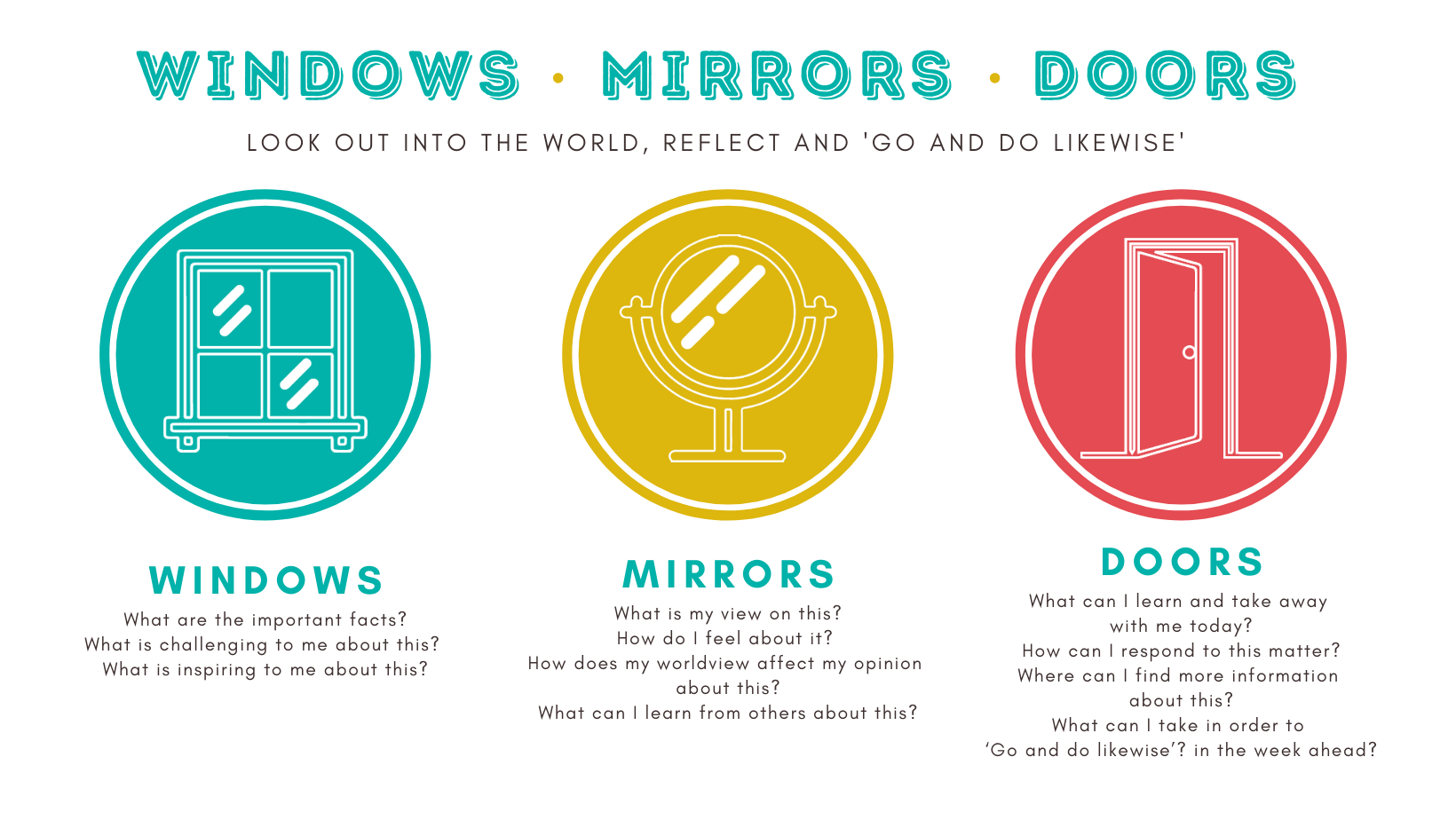
The above aspects can be explored through the concepts of windows, mirrors, and doors:
Windows (Encounter):
For children to become aware of God’s world in new ways, with children learning about life across the curriculum.
Mirrors (Reflection):
For children to reflect on their experiences; to meditate on life’s big questions and to consider some possible answers. This enables them to learn from life by exploring their own insights and perspectives and those of others.
Doors (Transformation):
For children to have opportunity to respond in a creative way as a means of expressing their thoughts and convictions. This enables them to put into action what they are coming to believe and value.
These windows, mirrors and doors support our Learning for Life ethos, ensuring that spiritual development is not confined to the classroom but becomes a lifelong journey of discovery and growth.
Implementation
The spiritual growth of pupils is not only dependent on learning in RE; opportunities for enhancing the spiritual well-being of learners are developed in every aspect of our school life. We support the whole school community to share this responsibility and to develop the shared language of spirituality. Opportunities are available for all to develop spiritually in our supportive and nurturing school inspired by our vision and lived out through our Christian values. Our Learning for Life commitment means that spiritual development is woven into the fabric of everything we do. Specific areas have also been identified which contribute to the spiritual growth of pupils.
Spirituality in Collective Worship
Collective Worship is the beating heart of St Peter’s CofE Infant School. It provides the opportunity for our school community to share experiences, ideas and understanding. It is the context in which the language of spirituality, which we use as a school, is regularly and explicitly shared. Collective Worship provides the opportunity for pupils to become aware of the importance of reflection and how our positive and negative experiences can be formative. It also provides a real sense of being present and still, which are often linked to invitations to pray.
Through daily Collective Worship, pupils are offered a space and a place for hearing the Christian story. They are offered an understanding of worship by being invited to participate in, or observe, Christian spiritual practices such as: prayer, reading and reflection on the Bible and liturgy and are introduced to different musical traditions. Opportunities to reflect on the WOWs of life such as beauty and joy of the world are given, as well as time to reflect and empathise with moments of disappointment or pain. Pupils are given time to consider their responsibilities to others and to grow in love and service. Time is given for celebration, both for the accomplishments of school members and to mark seasonal Christian festivals and celebrations in the calendars of other faiths. In this way pupils are offered time to be able to contemplate and develop spiritually. Collective Worship at St Peter’s CofE Infant School is invitational, inspirational and inclusive, embodying our Learning for Life values.
Spirituality in RE
The Church of England’s ‘Statement for Entitlement’ outlines the aims and expectations for Religious Education in CE schools and guides this school’s approach to RE and spirituality. The role of RE is neither to promote nor undermine organised religion but part of its purpose is to provide structured opportunity for consideration of the non-material aspects of life. RE can contribute dynamically to children and young people’s education by provoking challenging questions about meaning and purpose in life, beliefs about God, ultimate reality, issues of right and wrong and what it means to be human. It can support their own discovery of their personal spiritual journeys of meaning, purpose and value.
RE allows children to reflect upon and share their own knowledge and lived experiences, plus find out about the experiences, beliefs and traditions of other people. Through this process, children expand their knowledge, begin to shape their own beliefs, form opinions and add breadth to their world view. High quality RE lessons at St Peter’s CofE Infant School offer children opportunities that challenge their thinking through ‘Big Questions’. They critically reflect on their own religious, spiritual and/or philosophical convictions and are equipped with the skills to confidently discuss religious, spiritual and philosophical ideas. This approach supports our Learning for Life commitment by developing skills and understanding that will serve children throughout their lives.
Impact
Spirituality allows our children to love and respect themselves and enjoy good positive relationships with others. They take an interest and delight in the world around them and openly share their love of learning. They are open to what lies beyond, including in developing their spirituality, and for many, a faith and belief in God.
Pupils at St Peter’s CofE Infant School can articulate the school’s Christian vision – knowing that God has plans to give them hope and a future – and demonstrate a developing understanding of Christian and positive life values, including British Values. They are able to express, understand and manage their feelings as well as respecting those of others. They have a strong moral compass and engage in courageous advocacy projects. They are able to enjoy quiet and stillness. They possess an active imagination and show joy in creativity and discovering new skills.
Through our Learning for Life approach, children leave St Peter’s not only prepared for their next educational steps but equipped with spiritual awareness, resilience and values that will sustain them throughout their lives. They understand that spirituality – like the hole in the doughnut – is the invisible but essential part of who they are.
Spirituality within the Daily Life of the School
At St Peter’s CofE Infant School, we view spiritual growth as becoming more and more aware of one’s natural, innate spirituality. These opportunities happen throughout each and every day as children deal with delight, disappointment and the chance to be present with themselves. For this reason, every member of the school community is familiar with the school’s shared language of spirituality and will respond to pupils appropriately.
Throughout the daily life of the school, including lunch times and playtimes, pupils know that their references to ‘WOWs’ will be heard and taken seriously. They will be encouraged to reflect on these experiences and be comfortable about talking about spirituality – the invisible but essential part of who we are. Our Learning for Life ethos means that these everyday moments become powerful opportunities for spiritual growth and development. The impact of this can be seen in the behaviour of pupils, their relationships, and their growing understanding of self, others, the world and its beauty and their developing idea of the beyond.